
Former Under Secretary, Internal Security, in the ministry of home affairs RVS Mani has alleged that he was abused and tortured by officers of the Special Investigation Team during the United Progressive Alliance government to sign on a contradictory affidavit

Sharif in an interview had appeared to admit that terrorists sent by Pakistan were responsible for the 26/11 attacks.

Union Minister M Venkaiah Naidu alleged that by not allowing Parliament to function, Congress was not stopping the Modi government but "creating hurdles" in the country's development.

The 1993 Mumbai blasts convict will be woken up early on Thursday, given light refreshments and prayers books before his execution.

'In a fraction of a second everything started...'


The commission in 2012 had recorded the statement of these witnesses but due to an 'official understanding' between the Pakistani and Indian governments, had not cross-examined them.
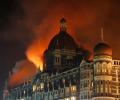
"Will never be able to forget that night," say Dr N P Vaswani and Devika Rotawan who both stared death in the face when Pakistani terrorists entered the city and opened fire at multiple spots.

'I was put in an anda cell. No window, light or air. Only grills.' 'During the monsoon, water would seep. There were rats running around all the time.' 'We were forced to sleep under bright lights all the time. Those bright lights are never switched off.'

Pakistani security and intelligence agencies have deployed a large number of personnel in plainclothes at Faridkot in Okara district of Punjab province, from where Ajmal hails, with journalists visiting the area having to face angry protests.
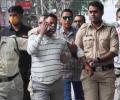
'The idea of subversive activities is so vague that it could include making fun of the government, being critical of the government.'

The founder of Lashkar-e-Tayiba also vowed to continue supporting Kashmiris.
Observing that the "mishandling" of the issue of Ajmal Iman's nationality by the government had brought bad name to Pakistan, leading human rights activist Ansar Burney has demanded the immediate resignation of Interior Ministry chief Rehman Malik.

Usman, said he hailed from Faislabad in Pakistan, and claimed he had entered Jammu 12 days ago.

The DGP said Jatt's killing, along with one of his associates, was a big success for the security forces.
Following is the chronology of events in 26/11 terror attack case in which the Supreme Court on Wednesday upheld the death sentence of lone Pakistani terrorist Mohammed Ajmal Amir Kasab:

The notification detaining Zakiur Rehman Lakhvi, the key planner of the 2008 Mumbai terror attacks, under a publc security order was on Monday suspended by the Islamabad high court.
'The government must covertly eliminate the leaders of terrorist organisations abroad so as to eliminate the problem at its roots,' recommends Brigadier Gurmeet Kanwal (retd).
'The government, supposedly manned by wise and experienced officers, was all at sea, unable to act cohesively, and with restraint. Each agency was out to score brownie points.'
Describing Rana as a flight risk, the US government opposed his release on bail, arguing that if he were to flee to Canada, he may escape the possibility of a death sentence in India.
The plea, filed in the apex court by advocate Ghanshyam Upadhyay, has referred to media reports and claimed that encounter of these five co-accused by the police is "not only extremely illegal, inhuman, but also it is shocking to the conscience of the court and is nothing but Talibanisation of the country, which cannot be countenanced at all".

'For Mallya, it seems 'the night is dark and full of terrors' and if you believe his lawyers, he's only looking for some sunshine,' says Veer Arjun Singh.

Hafiz Saeed, chief of terror outfit Lashkar-e-Tayiba and prime accused in the 26/11 Mumbai terror strike, has openly challenged India to prove that he is a terrorist.

India has voted against a UN General Assembly draft resolution calling for moratorium on the use of death penalty, saying it fails to recognise each nation's "sovereign right" to determine its legal system and punish criminals according to its laws.

We continue to be what we were before 26/11-- sitting ducks, says Mahesh Vijapurkar.
Both Major Iqbal and Major Pasha are shown as wanted accused in the charge sheet filed by the city police's crime branch in the case.
Sardar Mohammad Ghazi, dismissed for making controversial remarks on Kasab, said there were no differences of opinion when he had told senior government officials that Pakistan would have to seek the extradition of Kasab, the "prime suspect" in the Mumbai attacks case.
Kasab's lawyer Abbas Kazmi told rediff.com, "The most important point of Kasab's statement, while pleading guilty, was that he was helped by an Indian national Abu Jundal in Karachi. He taught Hindi to them."
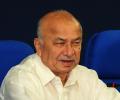
Home Minister Sushilkumar Shinde on Friday said a security cover is being provided to Delhi Chief Minister Arvind Kejriwal without his knowledge and despite his repeated rejection for it.

Suspected Indian Mujahideen terrorist Shahzad Ahmed, convicted in the 2008 Batla House encounter case, was sentenced to life imprisonment on Tuesday by a Delhi court for killing decorated police officer M C Sharma and injuring two other cops.

'Trail and appeals for rape cases must end in a year. Then the Police will not feel constrained to justify encounters and people will not applaud it.'

Mumbai is observing the sixth anniversary of the dastardly attacks that shook the city

'At some stage they will convert it to life imprisonment or something else,' says Former R&AW officer and author of Mission R&AW R K Yadav.
In yet another indication of the involvement of Pakistani establishment in the 26/11 Mumbai attack, LeT operative David Headley has corroborated the statement of lone captured terrorist Ajmal Amir Kasab that the terrorists got training from Pakistan Navy.
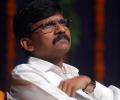
The Central Bureau of Investigation recently took over the probe in the case, based on a Patna police FIR related to alleged criminal conspiracy and abetment to suicide against Rajput's girlfriend and actor Rhea Chakraborty.
How Zabiuddin Ansari alias Abu Jundal, the Indian link in the 26/11 conspiracy, was captured after a painful 43-month chase.
A Mumbai Special Court, which conducted the trial of 26/11 terror strikes, is all set to announce the quantum of punishment on Thursday. The entire country is waiting for Judge M L Tahiliyani to pronounce punishment for lone surviving Pakistani terrorist--Ajmal Amir Kasab.
A gripping account of how Lashkar-e-Tayiba recruits trained for its fidayeen attack on Mumbai five years ago. An exclusive excerpt from The Siege: The Attack on The Taj, by Adrian Levy and Cathy Scott-Clark.
The trial of Mohammed Ajmal Amir Kasab, the lone terrorist arrested in the Mumbai terror attacks, will begin in the court at Arthur road Central jail on April 15, a special court said here today.
Maharashtra Home Minister Jayant Patil on Thursday showered praise on the Mumbai Crime Branch, which is investigating the 26/11 terrorist attacks, and claimed that the investigation done by it compelled Pakistan to finally admit that Mohammed Ajmal Amir Kasab was a Pakistani.Patil told reporters that the Mumbai Crime Branch investigated the case properly and collected evidences systematically, which forced Pakistan to admit that Kasab was its national.
